March 2026 weather event
As part of our region’s economic and business recovery support, Council would like to share some information below on behalf of our local agencies and the Queensland Government to understand what assistance regional businesses require.
Flood Recovery Support for Primary Producers and Small Businesses
Financial assistance is now available to primary producers and small businesses in parts of the Gladstone Region affected by recent flooding.
Primary Producers Rural Aid Support
Rural Aid is offering immediate financial assistance of up to $1000 for primary producers. Apply here.
Queensland Rural and Industry Development Authority (QRIDA) Support
Primary producers
If your property or operations have been affected, you may be eligible for:
- Grants up to $75,000 to help with clean-up and getting operations back up and running
- Loans up to $2 million to support recovery and ongoing business needs
- Freight subsidies up to $5,000 to assist with transporting livestock, fodder, fencing materials, equipment and machinery.
These supports are designed to help cover immediate recovery costs, repair damage, and keep your operations moving during recovery.
Small businesses
Support for small businesses in the Gladstone Region is being rolled out.
This will assist with recovery costs and help businesses reopen and continue operating.
More detailed information will be shared as programs are confirmed.
How to apply
Grants and loans: www.qrida.qld.gov.au
Freight subsidies: Department of Primary Industries – call 13 25 23
The Australian and Queensland Governments jointly fund this assistance under the Disaster Recovery Funding Arrangements (DRFA).
Personal Hardship Assistance
Gladstone Regional Council’s request for the activation of Personal Hardship Assistance Schemes (PHAS) has now been approved for all flood-impacted areas, with the following assistance available:
Income-Tested Grants (available across the entire Gladstone Local Government Area):
- Emergency Hardship Assistance Grant (EHCG)
- Structural Assistance Grant (SAG)
- Essential Services Safety and Reconnection Scheme (ESSRS)
The first step is to check your eligibility and submit an application through Queensland Community Recovery.
Eligibility and Applications can be made online at www.disaster.qld.gov.au or by calling the Queensland Community Recovery Hotline on 1800 173 349.
Regional Community Support Services
In the event of a disaster, Community Recovery works with a wide range of organisations to minimise the impact and ensure the recovery of affected communities. If you need assistance or support, please use this brochure for information and contact details for key community services in your local area.
Regional Community Support Services | CQ - Gladstone Districts(PDF, 387KB)
Community Outreach
Our Community Hubs have now concluded, and we thank everyone who attended and engaged with support services during this time.
If you or someone you know still requires assistance, please don’t hesitate to contact Council. We remain available to connect you with support agencies and assist with your ongoing recovery.
Primary producers
Financial assistance and donations
Recovery after flooding and high rainfall
Small business/Not for profit
Community support
Financial and support services for people impacted by disasters and emergencies
Residents impacted by disasters may be eligible for cost-free dumping of bulk, damaged goods at Council Transfer Stations and Benaraby Landfill.
Examples of disaster-related debris include:
- Clean-up activities inside and immediately outside a home (including removal of fallen trees and disaster waste)
- Removal of disaster-related debris, such as ash or silt-damaged furniture and white goods
- Removal of building material debris caused by the disaster (such as tiles, bricks and broken glass).
More information on Council Transfer Stations and Benaraby Landfill
Council's Recovery Group Structure(PDF, 161KB)
After an event, it is essential to ensure the safety of yourself and your family before commencing clean-up or trying to assist others. Remember to listen for weather warnings and advice.
Venturing outside or returning home after a disaster has occurred can be both physically and mentally challenging. Knowing what you can expect to see and deal with may help you adjust to the aftermath.
Things you can expect following an event include:
- Debris – and lots of it
- Possible damage to your home and/or contents
- Possible fallen power lines, which can also lead to loss of power
- Damage to driveways and property access
- Road closures
- Emergency services and response groups are working to assess and repair damage and provide assistance to the community (based on priority of greatest need)
- Possible loss of telecommunications
- Limited or no access to essential services, local businesses, and supplies
- If you have evacuated, it may be some time before Emergency Services declare it safe for you to return home. This is why you need to be prepared to be out of your home for several days to weeks.
- Displaced, injured or deceased animals. Pet owners are responsible for the management of their animals’ welfare, which may include payment for any vet bills or for the euthanasia of animals if needed.
- For injured wildlife, contact the wildlife carers closest to your location:
- Bundy Wildlife Rescue Inc.
- Gladstone & District Wildlife Carers Association Inc.
Check to see if neighbours, especially those with special needs, require assistance. If the situation is life-threatening, call '000'. If you have already checked in with your neighbours and still wish to help with the disaster recovery, there are several organisations you may contact to offer further assistance.
Donations
GIVIT is a national not-for-profit organisation connecting those who have with those who need, privately and safely. GIVIT matches donation offers with identified requests from a storm, fire, flood or cyclone-affected region, thereby eliminating the need for organisations to store and sort unexpected donations.
GIVIT is managing all offers of donated goods and services during the recovery in our Region and 100% of the donated money received by GIVIT will be used to purchase essential items. GIVIT purchases items from local providers to support the local economy as it also recovers.
If you want to donate goods to people who have been affected by a natural disaster in our Region, please pledge your offer at givit.org.au.
Donations for the March 2026 Weather Event can be made at GIVIT.
Volunteering
For those who think they would like to volunteer and assist, join a group that aligns with your interests before an event, so you are already enlisted and trained. Some examples of local volunteer groups:
Register with Register.Find.Reunite
This Australian Red Cross service allows our community to register, find and reunite family, friends and loved ones after an emergency or disaster event. Visit the Register.Find.Reunite website to register or for more information.
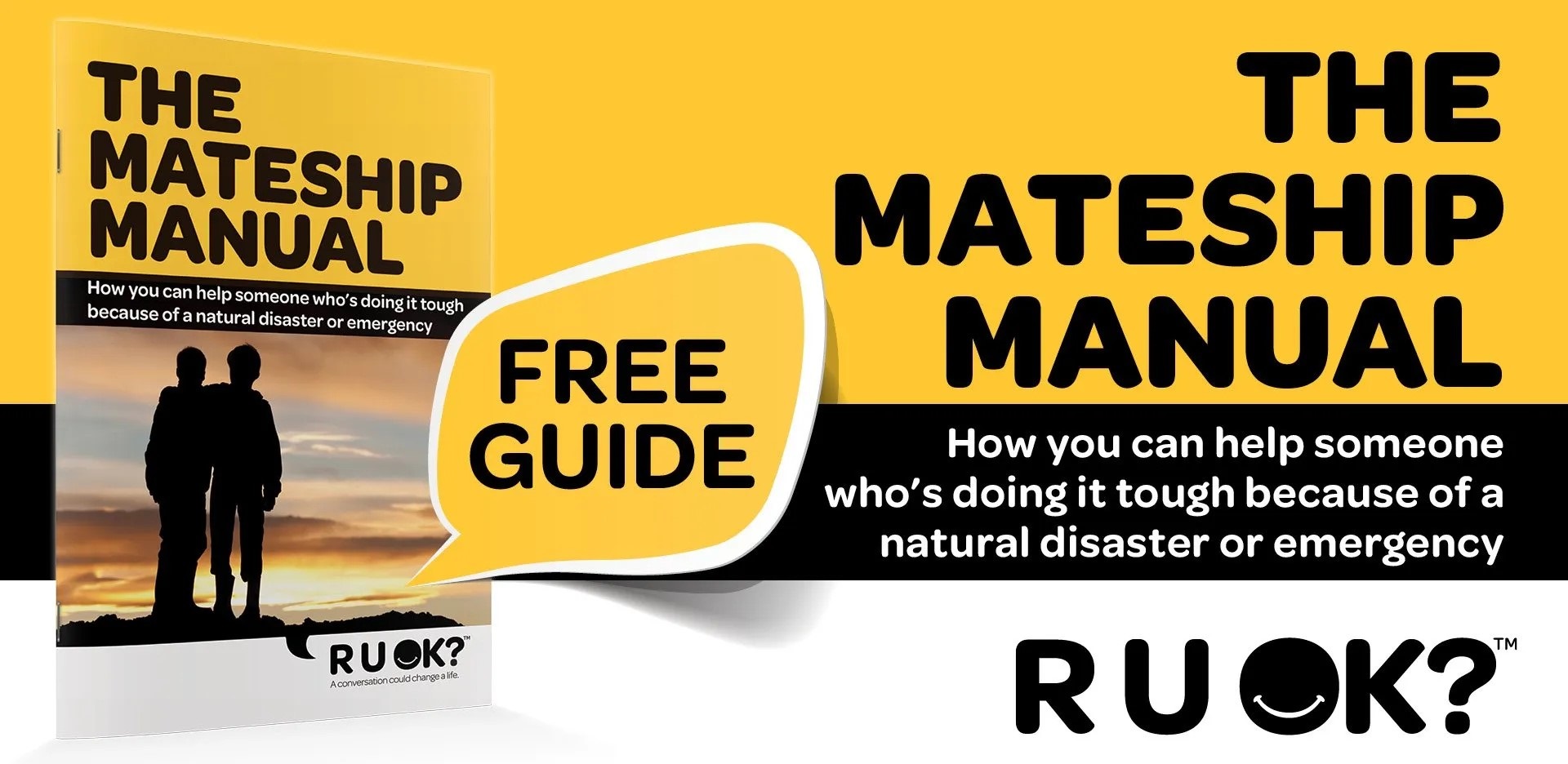
R U OK? Mateship Manual
How you can help someone who’s doing it tough because of a natural disaster or emergency
For people affected by a storm, flood, cyclone, or bushfire, it's important to stay healthy as you return home.